
A new dynamic is set to join the soccer scene of the southeastern United States. Enter: the Eastern Premier Soccer League.
The EPSL is a quickly expanding amateur league looking to carve out its space in the American soccer landscape further from its original northeastern location. Operating in the so-called fourth tier of the hypothetical American soccer pyramid, the EPSL operates in an affiliate partnership with amateur league NISA Nation as a regional division. Seeking to add some needed stability to a notoriously precarious lower league ecosystem, the EPSL pinpoints low cost of entry alongside regional proximity to build a foundation for a healthier and merit-based system of play.

NISA Nation is partnered with six regional affiliated leagues across the country as the top tier of amateur soccer in the NISA pyramid, which include the Cascadia Premier League, Eastern Premier Soccer League, Florida Gold Coast League, Metroplex Premier League, Mountain Premier League and Southwest Premier League. These leagues have further divisions within them, creating a vast, merit-based network of amateur clubs. Ideally, the champion of NISA Nation is then offered a promotion to the professional third division NISA, depending on that club meeting professional standards.
NISA Nation’s season culminates in National Championship, which teams can earn spots in as regional champions or champions of affiliate leagues. The first two National Champions, Northern Virginia FC and NY Greek Americans, both came from the EPSL.
Despite the EPSL’s more recent founding in 2020, the league boasts nationally recognized amateur clubs like Christos FC and Lansdowne Yonkers FC, who each captured attention with deep runs and upsets in the U.S. Open Cup, and the storied history of New York Greek American, who have been in operation since 1946.
The EPSL has also seen a number of players come through the league who have since moved up to the professional ranks, such as Canadian international and Minnesota United forward Tani Oluwaseyi and Philadelphia Union midfielder Nick Pariano.
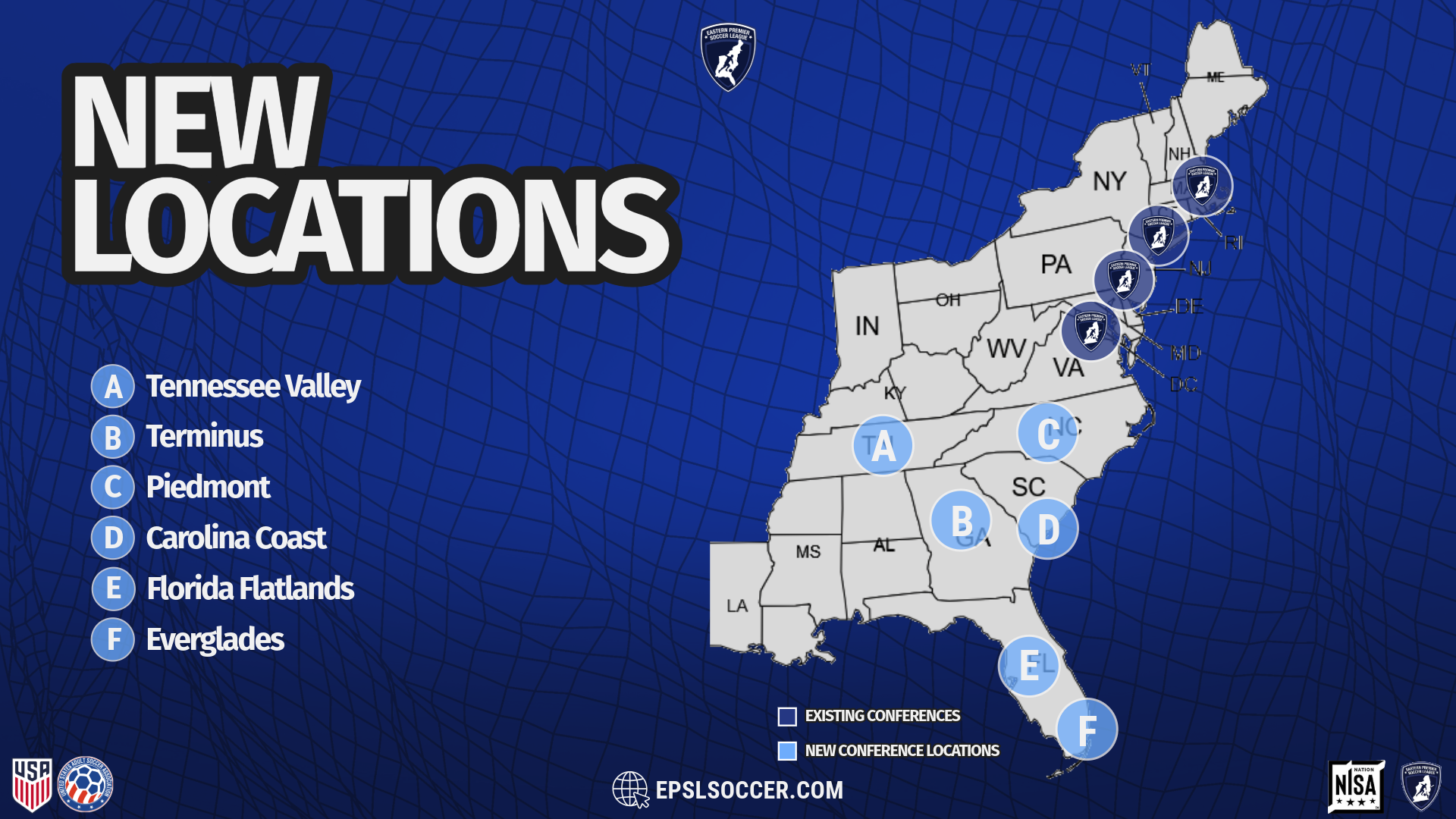
Now, the EPSL is looking to expand down into the southeastern region of the United States, an area rich in soccer interest but untouched by NISA Nation teams. In an announcement released in November, the ESPL released a graphic of future conference locations.

New conferences include locations like Tennessee, North Carolina, South Carolina, Georgia, and the Orlando and Miami areas of Florida, which will add to the existing four northeastern conferences of the Delaware River, Metropolitan, Mid-Atlantic, and Northeast.
The new conferences could start as soon as the spring of 2025 if interest allows, and definitely by the fall, according to the announcement.
In anticipation of the EPSL’s expansion into the southeast, we spoke with the Delaware River Conference Commissioner Aaron Sexton for more information on the league, and what to expect in future conferences:
With the recent report of NISA’s potential loss of sanctioning, how would something like this affect the EPSL and their affiliation?
Currently there is no official comment from US Soccer or NISA regarding their sanctioning so it’s probably not our place to comment on this at this moment.
(Editors’ note: A potential loss of sanctioning for NISA’s division three league would take away that door to professional status through promotion, but it doesn’t appear it would impact the EPSL’s operations in any other meaningful way.)
For these new conferences, is the EPSL looking more towards adding existing amateur sides, or for new teams to be created and enter? Is there a specific timeline for these conferences to form?
As it’ll be a new conference, we’re open to both existing and newly formed teams. A good example of this is our Philadelphia conference which started off with 4 clubs; 2 of which were existing and two were brand new or new to the Fall/Spring system. That conference has now grown to have 11 clubs and a strong feeder league – CASA Select – with an additional 16 or so clubs.
We’re aiming for Fall 2025 for many of our new conferences, but we may have some conferences that begin play in Spring 2025 depending on how quickly new clubs and leagues who wish to affiliate with us are identified and are able to begin play.
What do you view as the ideal number of teams, and the geographical distance between them?
Our conferences are capped at 12 teams as we don’t want to take every team from the local states, but rather to provide the best clubs a regional platform to play against one another. Once we reach our “build out” number, then teams would have to go through their local affiliated league to be promoted into the EPSL. Obviously the pro/rel aspect is our goal and therefore the ideal number, but our conferences are semi-indepedent so each conference can determine how many teams are promoted and relegated and at which point they want to implement this system. However, it’s worth also mentioning that we’ve started conferences with as few as 4 teams.
Our goal is for the average travel time to be under 1 hr 30 min to facilitate local “derbies”, increase fan engagement, and decrease travel costs for the member clubs and players. However, that’s not to say that if a club outside that area is willing to commit to regular travel to the conference “center” (Atlanta, in this case), that we wouldn’t consider them.
Finally, what excites you the most about expanding into the southeast? (Culture, fans, existing soccer infrastructure etc.)
Obviously the Southeast has a growing soccer culture. Anyone who’s paying attention can see that! But also logistically it’s the next logical step for our league to grow – same time zone, same travel corridor as many of our teams, and many cultural similarities between some cities in the South and our existing conferences.
To speak about Atlanta specifically, there’s a strong soccer culture historically but also with new advancements there’s a really strong wave behind soccer in the Atlanta Metro. Additional announcements such as USSF HQ being built, World Cup matches being hosted, etc, just goes to show the growing soccer culture in the Atlanta area. That leads us to believe there would be interested teams, players, etc, that belong in a semi-pro or high level amateur environment that we provide!
To hear more about the EPSL and their expansion plans, see the announcement video in full below.