
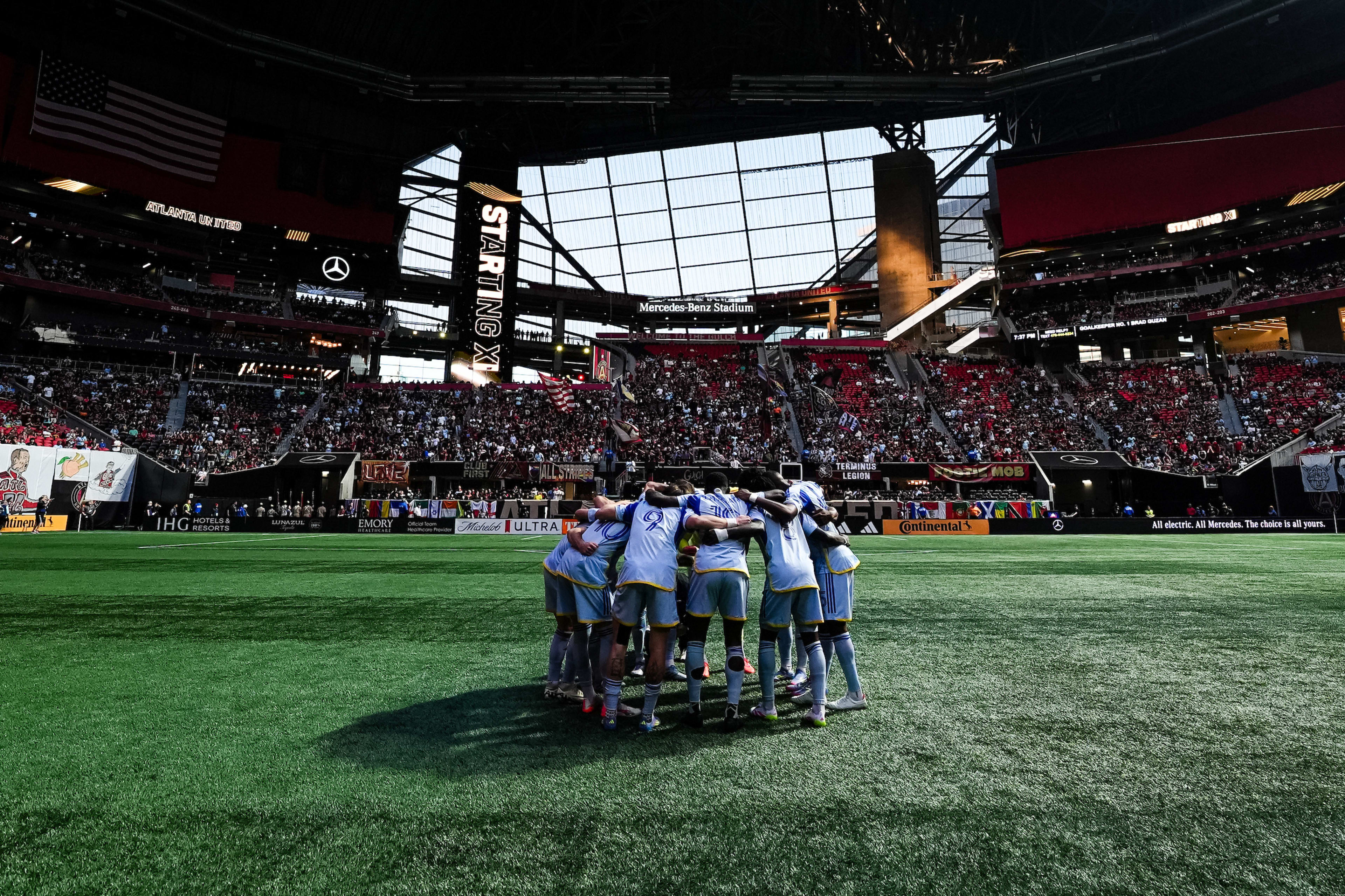
In a recent interview with Doug Roberson of The Atlanta Journal-Constitution, Atlanta United President Garth Lagerwey shared that there could be a lot of changes coming to the club’s roster as the team seeks to overcome the worst start to a season in club history. This comes amid growing pressure from fans and media to address the team’s struggles with on-field chemistry, confidence, execution, and fitness. For a team that has led Major League Soccer in international call-ups over the last two windows, the disconnect between on-paper talent and on-field results has been stark.
As reported by Roberson, the emphasis for Lagerway during this summer’s transfer window will be reinforcing the spine of the team, specifically centerbacks and central midfielders.
“That’s how I built every team I’ve ever had that’s had success. If you get those positions in the spine correct, then you got a really good chance of figuring out the rest,” Lagerwey said.
While the short-term answer for reinforcing the team’s spine may be through the transfer market, the long-term solution should be the club’s local talent pipeline. Despite the club’s focus on league-record signings and prime-age players, Atlanta United’s emerging heart and soul comes from its academy.
Homegrown Players Jay Fortune, Matt Edwards, Noah Cobb, and Will Reilly have been a silver lining for many fans through what has been a frustrating start to the 2025 season. Fans and media alike recognize the club’s young talent as a core group of players who exemplify the culture and ambitions of the team, the club, and the community. Refrains of “Play the kids” continue to ring out across all corners of the fanbase as the current wave of talent from Atlanta United’s Academy, which has risen to among the top 5 systems in Major League Soccer, showcases their highly athletic, tough, and tenacious mentality.
Fortune emerged as one of the best players on the team and one of the first names on the matchday line-up. Matt Edwards has quickly become a regular in the starting lineup, and Noah Cobb and Will Reilly have made their moments count. When asked about the impact of Jay Fortune in the midfield against Austin FC, Deila raved, “He did everything asked for. He is strong. He takes people on. He wins challenges. He has legs. This is our future. That’s how we need to have many of the others; many of the others have to have that boldness. We need to have more. That’s because that’s the only way to be champions. That is our goal.”
Just 10 days later, following the team’s victory at home against FC Cincinnati, Deila continued his effusive praise of Fortune, Matthews, and the young talent throughout the club: “We need some local players that we can build this team around.”
So, should Atlanta United shift its roster-building philosophy to put homegrown talent at the core rather than in supporting roles?
The simple answer is, “Probably.”
The club’s current roster-building philosophy, as described to us by Garth Lagerway and Chris Henderson, is to recruit prime-age players to be the core of a perennial championship-contending team. These prime-age players can be the Designated Players or can be buoyed by slightly older (or younger) impact DPs and TAM players. Anything the Homegrowns add to that is a luxury. As you may already be aware, Homegrown Players on the Supplemental Roster occupy roster spots 21-30 (or 31) and do not count against the club’s salary cap. If you get any significant contribution from these roles, that is already massive value in a league with limited opportunities to spread spending across your roster. If you have regular starters like Jay Fortune, Caleb Wiley, or George Bello playing practically for free (in a salary cap sense), then that makes the economics even better.
While this prime-age centric model is not inherently a bad approach, it does risk issues with building consistent team chemistry thanks to the ticking clock of what constitutes “prime-age.” As we have seen, this approach requires a group of expensive players willing to move to Major League Soccer at the height of their careers to play for three to four seasons and quickly build chemistry. This requires near-perfect scouting and recruitment to find the right fits as a player and a person for almost every transfer. It requires a special kind of player like Nico Lodeiro, who Lagerway described as a “dog” to Doug Roberson. Lagerway sees player availability and a lack of on-field leaders as what Atlanta United is lacking. While he thinks Latte Lath and/or Almiron are emotionally invested in the franchise enough to become that leader, they have not gotten there yet.
“It clearly hasn’t worked so far,” Lagerway said, “but if you ask what I learned from Seattle, it’s that guys who are really, really invested in the club will mostly come good in the end.”
I do not have a problem with recruiting these high-value players to enhance a team and deepen the roster at key positions, but I think the decision makers at the club are looking in the wrong places for the leadership Lagerway wants and the family culture Deila wants to implement within the squad. That leadership is emerging from within, and that core culture of what it means to be Atlanta United is deeply infused in every player that has risen through the academy.
“I joined [the Academy] when Atlanta won MLS Cup, and I think that kind of showed the first experience of what this club means and what they can do,” Fortune said in a recent player profile on the club’s website. “To see the stadium packed out all everybody having fun winning games, that’s not something you can get at every team in the league. For me, I really appreciate the type of fans that we have here. Every time I put the shirt on, I’m not just doing it for myself or for my teammates, but the fans and the people that are working as backroom staff as well, because they gave me the chance and opportunity to be where I am.”
Years of growth by the players and Atlanta United’s academy staff under Tony Annan, Matt Lawrey, and now Javier Perez have turned the slow drip of first-team talent into waves of mature and hard-working young professionals ready to prove themselves. Three months ago, we identified a few young players whom we were watching closely this year. Since then, that list has grown as an impressive (and growing) number of academy products represent their home countries on the international stage.
Now, I am not suggesting that Atlanta United should shift its approach to resemble FC Dallas, or even attempt to replicate Philadelphia Union’s successes. What I am suggesting is that Garth Lagerway, Chris Henderson, and Ronny Deila should recognize that the strongest and deepest parts of the club’s emerging talent pool are at centerback, central midfielder, and goalkeeper, and that they should use the transfer market to build around and enhance a young, talented, and local core so that they will be able to grow together into their prime-age years.
Atlanta’s new core of local talent could grow into its prime years together. Fortune (22) and Efrain Morales (21) are working through their second contracts with the club that run through the end of 2026. Matthew Edwards and Will Reilly (both 22 years old) are both signed through 2027, with Reilly’s contract lasting through 2028. Noah Cobb (turns 20 in July) is under contract through 2027, his age-22 season. Jayden Hibbert (20), Ashton Gordon (17), Cooper Sanchez (17), Adyn Torres (17), and Luke Brennan (19) are signed through 2028, and Dom Chong Qui (16) through 2029.
The face of our current youth movement is emerging team leader Jay Fortune. Fortune is an unofficial captain of this team, one of the best players on the field for Atlanta United since last September, and a future star for Trinidad & Tobago as they compete for their first World Cup qualification since 2006.
Ahead of Fortune’s 23rd birthday in December, the team should sign him to an extension as a U-22 Initiative Player. His Homegrown Player contract has an option for the 2026 season, but the club should invest in his long-term role at the heart of our midfield. With (at least) two U-22 Player spots available, one should be reserved to extend Fortune through 2028 on a substantial raise from the modest $71,401 salary he earned in 2024. Using a U-22 Player spot for Fortune allows him a generous pay raise and additional years of guaranteed stability with the club, while only counting $200,000 against the salary cap.
With Fortune secured through his age-25 season in 2028, Atlanta’s central midfield core will be mostly set with Fortune, Reilly, Sanchez, Torres, and potentially Brendan Lambe returning from the University of Virginia in 2027. The club is also exceptionally wealthy with emerging defensive talent like USA U-20 international Noah Cobb, Bolivian international Efrain Morales, Matt Edwards, and US U-18 internationals Dominik Chong Qui, Kaiden Moore, and Braden Dunham. Atlanta United is also set to welcome back top college defensive talents like Northwestern University’s captain, Nigel Prince, and Clemson’s Remi Okunlola. The club also has a clear line of succession behind Brad Guzan at goalkeeper, with 2024 SuperDraft pick Jayden Hibbert improving with every match, Canadian U-17 international Jonathan Ransom excelling with Atlanta United 2, and USA youth international James Donaldson waiting in the wings. Beyond the spine of the team, Luke Brennan has also impressed with the USA U-20s and leads an intriguing group of young, dynamic attacking players who could enhance Atlanta’s high-priced, high-octane attack.
When we start to examine the current roster and what kinds of players we have on the way through the development pipeline, we see a wealth of talented, hungry, and mature players who are deeply invested in the success of their hometown side and who excel at the positions Atlanta United’s brain trust wants the build around. The best part is that the players who are already making an outsized impact on the field will enter their prime-age years in their first or second contracts with the club, creating a stable, affordable, and sustainable core group of players to build around.
Brad Guzan and Mateusz Klich are in the last year of their contract, and Edwin Mosquera, Luis Abram, Derrick Williams, Efrain Morales, Brooks Lennon, Ronald Hernandez, Matthew Edwards, Jamal Thiare, Cayman Togashi, Josh Cohen, Jayden Hibbert, Jay Fortune, and William Reilly are all on option years. Saba Lobjanide is signed through 2026, along with Tristan Muyumba and Pedro Amador, who have options for 2027. Bartosz Slisz, Stian Gregersen, and the team’s three Designated Players are all signed through 2028.
So, heading into the next two windows, Chris Henderson, Ronny Deila, and Garth Lagerway have an important decision to make. They could retain most of the roster they have built with some minor changes, or they could conduct a transformative rebuild. They could maintain their current approach by trying to buy a core of players, centering their current Designated Players and imported prime-age players in their rebuild, or they could cultivate around an emerging core of soon-to-be prime-age players and recruit the kinds of players that will help this young core thrive.
We will have to wait and see which way Atlanta United’s braintrust will go as they work to improve the roster, but in my humble opinion, the clearest path to a balanced roster with a sustainable core leadership group and impressive depth up the spine of the formation is through Atlanta United-grown players. Not all of our prospects will stay through their prime years, but if given the chance and surrounded by all of the resources this club can bring to bear, core players like Cobb, Edwards, Reilly, and Fortune could usher in a new golden age at the Benz.
The homegrowns are good places to build up players, but let’s not act like they’re the next phase of starters. They need minutes, they need mentors, they need veterans showing them what they need to know. They also need drive. I see this in Cobb, I don’t see it as much in Edwards as an example.
Fortune is finally coming into his form but Brennan and Hibbert are still building themselves up.
I’m not sure ATL2 time is valuable enough though, they need 1st team minutes, but that means we need a good core of talent to be able to sub them out and use these homegrowns in a place of holding onto a game, not giving it up.
While some of our homegrowns may show some promise, in my opinion, they are not to the level we can build around. I think they’re OK back ups for now. They have a long way to develop…
it does seem like most of our better homegrown prospects are defensive side players, so it what we are doing in getting DP players for the attacking side is fine. But the whole group has to mesh well. we are currently not meshing well together.
I agree that we are not meshing well together. The idea that inspired this article is what I felt was the internal contradiction that we see, which I believe is causing this disorder.
We aspire to be like the teams and organizations that have a strong sense of self, a deep understanding of who they are, and an internal culture that welcomes newcomers while also integrating their unique gifts and abilities to enhance the system. Due to the widespread turnover our organization has faced since 2018/2019, the only continuity comes from the academy. Those players represent a culture of hard work, determination, pride for their community, a selfless work ethic, and a deep love for the fans and support staff. A lot of these players remember when Atlanta United won their last championship and were either in the academy then or were about to join it. They know what it means to be Atlanta. The problem is that they are young, and young players often have to defer to older and higher-paid players. In our case, Fortune and Cobb are natural leaders ready to take the stage as the faces of our club.
I believe a lot of issues would begin to clear themselves up if we didn’t expect new players to instantly be the creators and torch-bearers of club culture; rather, we welcome them into a family, a culture, and a community that wants to help them shine. We should be using our internal stability, our local core, to help integrate new players rather than expecting them to be everything while they are trying to get settled into a new country/community/club. We should be making it as easy as possible for them to focus on what they can do on the field to help this team win.
I think you can put a few in core positions and as solid starters but you still need marquee players and a willing to spend. If this is abandoned, you may as well cover up the 200 section. As you correctly pointed out, you don’t want to be Dallas. Otherwise, the Benz would be too big.
With actual attendance being what it is, could probably cover up the 200 section now.