
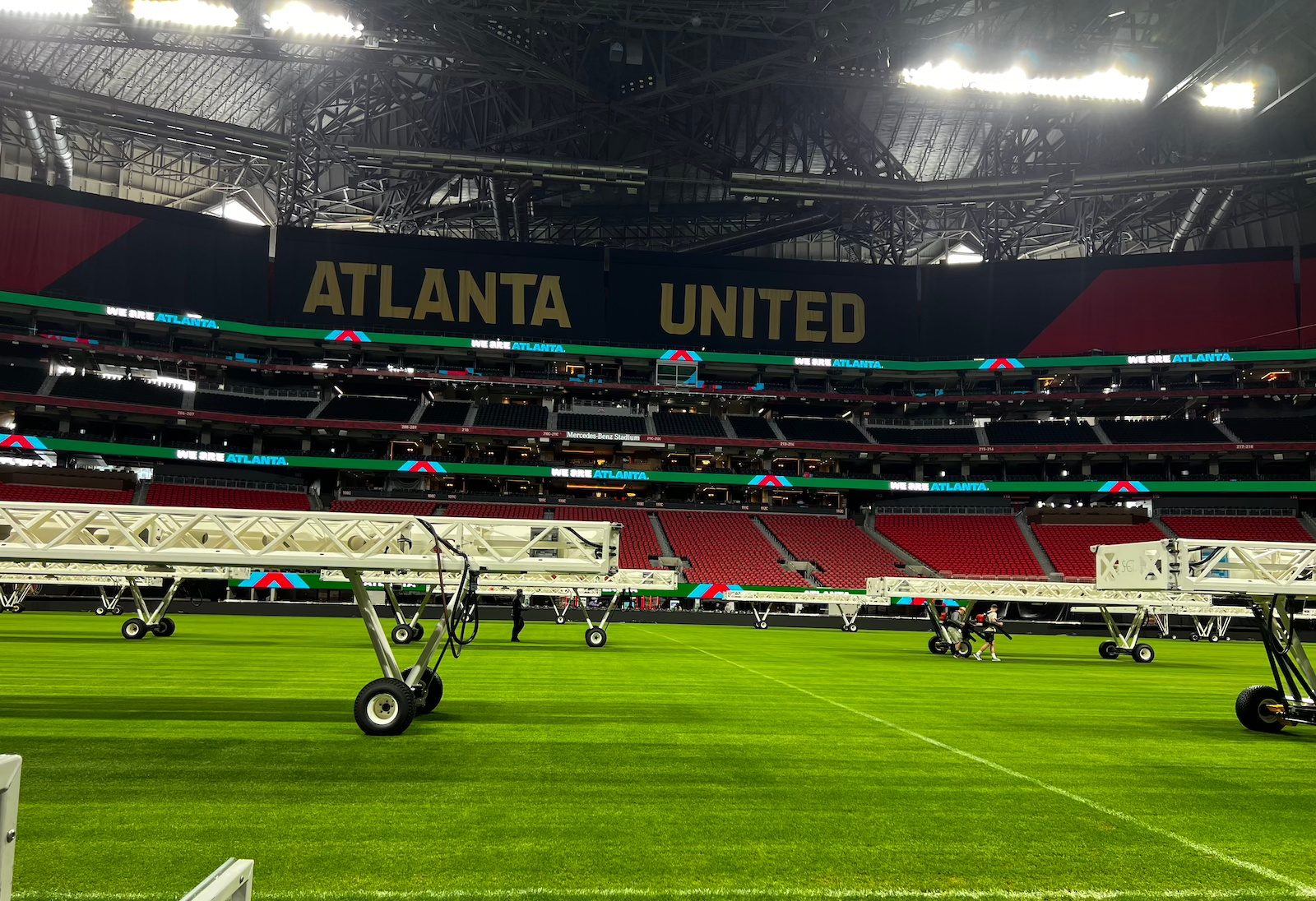
While yesterday consisted of tons of updates related to Atlanta’s FIFA 2026 World Cup preparations, one of the changes most directly and immediately impacting Atlanta United is the installation of the new grass pitch inside Mercedes-Benz Stadium. The grass has been a blazing topic over the past couple of years as the Benz has hosted events like Copa America and SheBelieves Cup, where those versions were meant to be a temporary solution. This new ryegrass blend, though, and the manner in which it was equipped, is designed to be quite literally the same exact surface you’d find on outdoor professional soccer pitches and football fields across the world. I took a moment yesterday to nerd out about it with Adam Fullerton, VP of Stadium Operations at Mercedes-Benz Stadium, since it’s become one of the most common topics folks inquire about.
Let’s first dive into exactly how the temporary versions were installed, because there’s obviously a significant difference. Back then, the artificial turf at the stadium was left in place, and a concert floor was just laid on top of that surface. From there, the floor was covered with sand and then the sod was laid on top of it and stitched together. When read, it sounds like a fairly simple process, but it was clearly a significant undertaking for each event.

This new surface consisted of preparations far beyond just covering the old surface. That old turf, which Atlanta installed back at the beginning of 2024, was completely ripped out at the beginning of 2026. The staff at the Benz then drilled out a foot of asphalt before adding an airflow and vacuum system (SubAir), along with an irrigation system with 27 different zones. To give an idea of what the SubAir system does, it vacuums out excess moisture 36 times faster than if gravity alone were in charge. Their website notes that what would normally take an hour to drain can be cleared in only three minutes. On the flip side, the system forces fresh air through those pipes to help oxygenate the roots and keep the soil temperatures stable. For all the golf aficionados out there, it’s essentially the same system that’s used at The Masters to control humidity, and Augusta National is where the technology was truly pioneered.
Layered on top of that is the rock and sand mixture, which Adam noted took about four days of hauling in dump trucks followed by the painstaking work of leveling the sand properly.
Finally, the ryegrass, which had already been growing up in north Georgia on a base of synthetic fiber material, is laid out over the top of the sand. The roots, which are already established in the synthetic material, then continue growing down into the sand to totally stabilize the surface. The weight of the grass, coupled with the interspersed root system interlocking with the material then added to the actual sand, creates a system that doesn’t have the bounciness of the prior versions.
The current grass will actually be ripped out in May before the actual World Cup pitch is laid down. Fullerton stated the only difference is that the current version has the hybrid material already stitched into the grass at the farm, while the FIFA pitch – coming from a FIFA-contracted farm in Colorado – will have the hybrid material stitched in onsite at Mercedes-Benz Stadium. They’ll use what’s best described as a giant sewing machine to add in the fiber.
For context, the vast majority of Premier League stadiums use a similar or identical system, along with others like Barcelona’s Camp Nou, Bayern Munich’s Allianz Arena, and a handful of American Football fields and rugby fields.
Mercedes-Benz Stadium’s staff has visited a variety of locations to learn these systems and incorporated FIFA’s expertise. Michigan State and the University of Tennessee have doctorate-level scientists working with FIFA to replicate the exact conditions in grow labs of each World Cup venue to determine which type of grass will best grow in each stadium. The Benz, with its enclosed roof, is unique because of the temperature, and those scientists helped determine the ryegrass blend coupled with the SubAir system will be the best combination of stability and regrowth rate.
Adam also uses the expertise of one of the stadium’s former groundskeepers, Nick Pappas a.k.a. the turf guru, who now oversees NFL fields, the past few Super Bowls, and all international NFL surfaces including the one utilized at the Bernabeu in Madrid. All of these resources have combined into a wealth of information and planning, which Fullerton said the stadium staff is following precisely.
As for the day-to-day management, the groundskeeping staff takes measurements and data every day to determine if they need to water, cut, blow, or perform any other of a variety of tasks to keep the grass in perfect condition. That includes rotating the massive UV lights over portions of the grass to provide the necessary lighting 12 hours a day.

Atlanta United has already given the surface its first true run last Saturday, and will continue to do so over the next several weekends. The USMNT will supplement the usage in friendlies against Belgium and Portugal at the end of March, giving Fullerton and his team a ton of data to continue to fine tune everything leading up to the World Cup in June and July. For now, it’s about keeping that carpet as pristine as possible until the end of the World Cup, when a new turf field will be laid back down.
Help support independent Atlanta soccer coverage
Every week, Scarves and Spikes brings you original interviews, on-site coverage, live shows/podcasts, and the analysis you won’t find at the bigger national outlets. With 2026 being a World Cup year, Atlanta United facing yet another important transfer window, the U.S. Soccer National Training Center setting up shop in the Atlanta area, and NWSL Atlanta kicking off in 2028, your support helps us do even more.
What you get on Patreon:
- Atlanta United training ground updates
- Exclusive interviews, like our recent sit-down with ATL UTD 2 head coach Jose Silva
- Discord access, talk Atlanta soccer with the SnS team and other supporters
- Patreon-only mailbags
- Grey Gowder’s analytical deep-dives on roster construction, the academy, ATL UTD 2, and more
Membership starts at $5/month. New subscribers get a 7-day free trial.
The pitch looked fantastic in the first match, and seemed to hold up really well. I wonder how much more expensive it would be to have this as a permanent pitch versus the artificial turf. If it is within reason, switch to the grass permanently.
They won’t make the switch to grass due to the cost of managing the grass. Turf is always going to be cheaper to maintain
Also, MBS (in a normal year) hosts numerous events (concerts, corporate events, etc) that would not be possible if the field was grass. Hence, enjoy the grass while it last. It will not be around after the WC.
Like they said, it’d be nice, and I’ll add it to the article, but once the World Cup is over a new set of turf is being laid back down. It’d be cool though
Now with all this expertise and equipment in place, just keep this process permanently for the Falcons and UTD!
See above. Unfortunately, not gonna happen.