
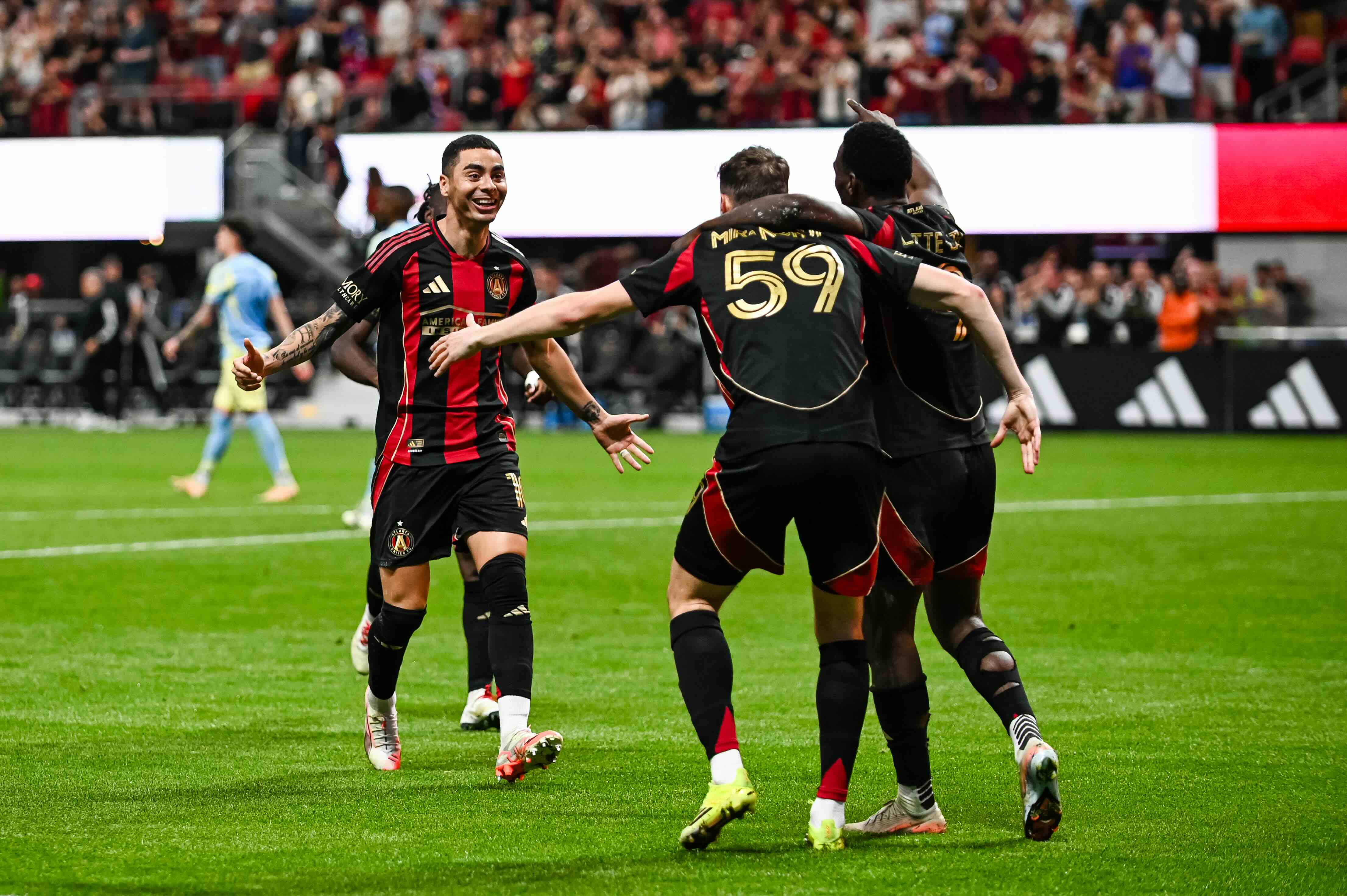
Atlanta United fans were probably hoping the team would be a bit better than four points from dead last before the FIFA World Cup break, but alas, that’s where we’re at, folks.
It’s times like these where we often find ourselves playing the blame game to single out a cause for the poor results. Naturally, the Designated Players are the first ones we point a finger at because they are typically the highest-paid players and are supposed to be the faces of the team. If the players in this premium roster category aren’t helping their team win games, then it’s probably a sign the money on them isn’t being spent very well.
As you may be aware, MLSPA has released its spring 2026 salary guide, which details how much each player in the league is earning. To no surprise, Atlanta United’s DPs are among the highest-paid players in the league, which is what makes their underperformance over the past two seasons very alarming.
Miguel Almirón: $7,871,000 (5th highest in MLS)
Alexey Miranchuk: $5,085,441 (13th highest in MLS)
Emmanuel Latte Lath: $3,736,000 (23rd highest in MLS)
This made me curious as to how much the Five Stripes are getting from their star players compared to some of the other teams around the league, who may be investing more or less. That’s what I’ll be exploring in this article with a series of data visualizations.
Before we get into the graphs, I want to point out that this is not a full analysis of Atlanta United player salaries. If that interests you, go check out the article Sydney wrote earlier this week.
Without further ado, let’s jump into the data.
Method 1: Raw DP production (goals + assists)
The first method I tried to visualize this was to compare the most direct and tangible proof of DP effectiveness in Major League Soccer: goals and assists. After all, those are the things that win games, right?
So I created a graph that showed the total that each club was spending annually on its DPs and the total goal contributions they received from them as of May 12, 2026.
Author’s note: All of the graphs in this article are interactive, so you can hover/click on each data point to see more information.
To nobody’s surprise, Atlanta United, the club currently in 28th place in the Supporters’ Shield Standings despite boasting the 2nd-highest DP salary spend ($16,692,441) behind Inter Miami ($41,845,853), is not getting as much from its stars as other teams. In fact, 11 teams in MLS are spending less on their DPs than the Five Stripes, yet they are receiving equal or greater production from them. That’s just over a third of the league that is getting more bang for its buck in the attack from its franchise players.
Notably, rival Nashville SC has found tremendous success with its DP trio of Sam Surridge (9 goals), Cristian Espinoza (3g/5a) and Hany Mukhtar (3g/5a) while spending less than $14 million on their combined salaries. Even more shocking is how much teams like the Colorado Rapids and FC Dallas are getting despite being in the bottom seven in DP salary spend in MLS. With DP duo Rafael Navarro (7g/4a) and Paxten Aaronson (3g/2a) coming in at a combined $3,677,663, the Rapids have managed a greater end product than the Five Stripes while spending less than what Atlanta is on its lowest-paid DP (Latte Lath is sitting at $3,736,000).
The individual player data really illustrate how little Atlanta is getting from its DPs compared to other teams.
Of course, Miguel Almirón sticks out like a sore thumb for being the fifth-highest paid player in MLS, yet only producing three assists in 2026. Only 12 of the league’s 72 DPs have fewer goal contributions than the Paraguayan international. Although technically on the right side of the trend line, Latte Lath’s 2g/2a pales when compared to other center forwards at a similar or lower salary, such as Chicago Fire’s Hugo Cuypers (11g/1a for $3,528,044) or FC Dallas’ Petar Musa (10g/2a for $2,880,000).
There is some good news, however, and it comes from Alexey Miranchuk. Although his salary is one of the highest in the league, his production of 5g/2a is comparable to that of proven MLS attacking midfielders such as FC Cincinnati’s Evander (6g/1a), Orlando City’s Martín Ojeda (7g) and New England Revolution’s Carles Gil (4g/4a). It looks even better when you consider that the Russian international has played fewer minutes this season than either of those three.
While this method yielded some good comparisons, I quickly realized it had its flaws. For starters, it doesn’t take into consideration minutes played, another important variable that determines production. It’s much more impressive when you see that Sam Surridge has nine goals in 440 minutes than for LAFC’s Denis Bouanga to have nine goal contributions in almost twice the minutes.
The other problem is that teams don’t exclusively use their DP slots on attacking players. Some, like New York City FC and FC Cincinnati, have DP defenders, while teams like New England and St. Louis CITY SC have one of their premium roster slots occupied by a goalkeeper. Obviously, evaluating the return on investment for defenders and goalkeepers based on goals and assists makes no sense because their main job is to prevent opposing goals. That’s why these graphs don’t account for those players and only compare midfielders and forwards.
Fortunately, there is a method that solves both problems.
Method 2: Raw G+ normalized by 96 minutes
The amazing folks over at American Soccer Analysis created the goals added metric a while back, and so far, I’ve found it to be one of the best statistics for holistically comparing player quality. Nothing beats the eye test from my point of view, but G+ gets pretty darn close.
If you’re not familiar with G+, I recommend you check out ASA’s explainer article. In a few words, G+ measures how much each player’s touches affect their team’s chances of scoring or conceding. ASA’s G+ database also allows you to normalize the data by 96 minutes, so that’s exactly what I did to construct these graphs.
Already, it’s quite a different picture from the graph showing goal contributions: LA Galaxy jumped dramatically, Austin FC nosedived and Atlanta United somehow actually finds itself barely above the trend line.
What does this mean from an Atlanta United perspective? Well, let’s take a look at where the individual players stand first.
At first glance, it surprised me to see all three of Atlanta United’s DPs above the line of best fit, which suggests that they are performing to the level that would be expected of them based on their salaries. However, don’t get hung up on the trend line for the simple fact that Lionel Messi is and always will be the outlier that significantly distorts the average. That’s why I created another version without Messi, where you can clearly see the line shifts and all three of Atlanta’s DPs now fall below the line.
I was very surprised to see Miguel Almirón with such a high G+ rating, considering he has significantly fewer goal contributions than players like Nicolás Fernández Mercau (0.32 G+), Carles Gil (0.3 G+), and even Sam Surridge (0.25 G+).
Upon closer inspection, it seems Almirón is doing what he’s supposed to (kinda). His dribbling G+ of 0.12 is the fifth highest in the league, and his passing G+ of 0.05 is in the top 20. These are the categories that matter most at his position, and he’s excelling in them.
The problem is that he’s the fifth-highest-paid player in the league. If you’re spending almost $8 million on a premium attacker, you probably want them performing a level above their counterparts who are making half as much. The same can be said of Miranchuk and Latte Lath, and that’s without diving into their transfer fees.
Now, does Arthur Blank care if he’s paying a DP $2 million or $20 million? Probably not, as long as that player is noticeably raising the level of the team as DPs should. None of Atlanta’s DPs are currently doing that, suggesting that what they are generating isn’t worth the investment being poured into them.
Other teams across the league have demonstrated that you don’t need to break the bank to find stellar talent. Sometimes, you don’t even need that talent to be in the form of DPs. If Atlanta is going to go and pay a player tens of millions of dollars, they need to make sure that they know what they’re paying for, especially if these players are going to be locked down with lengthy contracts.
So my answer to the question posed in the title of this article is no. I do not believe Atlanta United is getting its money’s worth from its DPs. When you pay a premium, you expect premium production. That simply isn’t happening. While there are glaring holes in other parts of the roster, these three form one of the most expensive attacks in the league and have scored the third-fewest goals in MLS this season.
I guess money can’t solve all your problems, huh?
Help support independent Atlanta soccer coverage
Every week, Scarves and Spikes brings you original interviews, on-site coverage, live shows/podcasts, and the analysis you won’t find at the bigger national outlets. With 2026 being a World Cup year, Atlanta United facing yet another important transfer window, the U.S. Soccer National Training Center setting up shop in the Atlanta area, and NWSL Atlanta kicking off in 2028, your support helps us do even more.
What you get on Patreon:
- Atlanta United training ground updates
- Exclusive interviews, like our recent sit-down with ATL UTD 2 head coach Jose Silva
- Discord access, talk Atlanta soccer with the SnS team and other supporters
- Patreon-only mailbags
- Grey Gowder’s analytical deep-dives on roster construction, the academy, ATL UTD 2, and more
Membership starts at $5/month. New subscribers get a 7-day free trial.
I think the league is starting to get to a point where, in most cases, its less a case of DPs carrying teams as much as it is having a supporting cast thats capable of playing better than the sum of the parts and DPs that are capable of not only “producing” but elevating the play of those around them.
We could have 5 more contributions from our DPs and be 3rd in the league in DP goal contributions and still be a mid table team in the east.
Think back to Almada, a guy who played 26 games in La Liga and 7 champions league games this year. A class above the league at the time and yet we were still mid table at best.
We are roster building like its 2015. And I dont think it really matters who you slot in with this group as a DP. We have a supporting cast who, despite being capable professional footballers, bring no game-breaking traits that can be leveraged to tilt a game in our favor.
I think it’s a bit harsh to say that ALL of Atlanta’s DPs aren’t raising the level of the team when Miranchuk has been carrying the attack all spring and is pretty much the reason we are still in contention for silverware this year.
This could have been an email! :-/
I would like to see the charts with out Messi like the last one. My guess is if Messi is removed atl will be below the trend line on every chart.
Could have been the shortest article ever.
No.
But I appreciate the analysis.
This also leads to the question of is Atlanta United the team getting their money’s worth or is Atlanta United the organization. This article plus the results on the field point to the answer to the first one being no. But Miggy sales jerseys, and ELL could have been planned as a future sale for profit.
I find it curious and slightly informative that Frank de Boer has the highest winning % of any Atlanta United mgr…and two trophies…but depending on who you ask, was dumped either because the play was “boring” or lost control of the locker room or doesn’t understand futbol. Tata I is second…everything else, including Tata II, is dismal.
I’m not going to take a side, but to be fair, some argue FdB only did well because he inherited a team of stars that was mostly built by Tata. It also currently explains why Tata II is still dismal.
I’m not saying this is all actually true (I haven’t done the work to further justify or disprove it), just an argument I’ve heard to dismiss FdB’s success, warranted or not.
Well, somehow his record was better than Tata I…Tata had a few more games in that tally but FdB wasn’t far behind. So by similar logic, guess we’d have to conclude FdB is better unless the roster got better as well, which isn’t the case imo. Probably some arguments to be made about Tata’s trajectory (and how the game catches up to certain tactics, etc). Regardless, you’ll get no argument from me…rosters matter and this one is…not good.
We lost prime Miggy to Newcastle literally two days before the first friendly. If the deal fell through, we would have had 4 DPs on the books and a rapid need to ship one off. Garza, apparently one of the key veterans in the locker room, had also gotten a raw deal from the FO in the offseason. Any new coach coming into that locker room was going to need some time to connect with the team.
Big what ifs to me on de Boer are 1) what happens if Josef doesn’t tear his ACL in the 2020 opener in Nashville and 2) what if he had leveraged performances to shift to AU building up and KEEPING academy players and homegrowns
The fanbase and (some) media vitriol towards FdB has always been over the top, and somewhat unfair IMO.
I’m not a huge fan of his, but yes – we did have success, with a lesser team (in Pity and Barco) and that year was fun for me because I like winning. I remember those accolades. Win first, style second.
Though he probably shouldn’t have said it, and I think his point was a little out of context, what FDB said about our fanbase at the time was correct. We were spoiled.
Makes one think perhaps the fanbase shares some blame
As long as Boca was driving things, it was always going to end up in the ditch. Yes, losing Josef in the first game was a big blow, and covid was another blow, but the signs were there before FdB was fired.
The worst 6 months in Atlanta United History
2019 October – Parkhurst retires
2019 November – Nagbe leaves Atlanta
2019 December – Tito leaves Atlanta
2020 January – Gressel leaves Atlanta
2020 February – Josef gets injured
2020 March – The world shuts down due to COVID
Atlanta has never been the same since.
FDB har to go. Not cause he had bad stats, but at that point atlanta was playing exciting soccer to non-fans. Meaning you could love football and still enjoy atl soccer. FDB inherited an amazing team. But since Tata left they dropped the ball in several areas. Most recently is not bringing back Joseph with almiron coming back. Half the reason almiron was so amazing was his connection with Joseph. They have brought players who were individually good, but does not fit the team play style. There has been little understanding/belief/communication between the front office and the head coach. This has results in us getting players who are good but don’t fit or just rushing to get players. Coaches and players not fitting. I hoped Garth coming in would fix it, but he made it 1,000 times worse. I think he was used to working with little budget and made the best of it. Then he got blank checks and thought he could solve it with money and less thought. He failed.
the simple answer to the title question is NO – Atlanta is not getting its money’s worth. That said, I think that if we had a true, high performing striker (in the Josef mold of 2018), the metrics would look significantly different.
As much as DPs are important, but the mid level players need to play to their levels as well. Clearly both DPs and TAMs players are not playing up to their levels for Atlanta.
Not only are most of the TAM players underperforming, look at that poor allocation of resources. We have THREE center backs on TAM deals, including our two highest paid (non-DP) players in Mihaj and Berrocal. We pay basically $3 million for two players that share one slot in the lineup. Neither plays anything close to a high-TAM player, either. Alzate is the next highest-paid player, and we’ve seen Galarza, Fortune, and Sanchez all thoroughly outplay him over the last several weeks. Saba isn’t really generating enough end production for that salary designation, either.
At least Berrocal’s loan is up and it’ll cost nothing to open up that slot and cap hit. Before the year, I thought Muyumba and/or even Saba might be buyout candidates, but with their deals set to expire (IIRC) in the winter, might as just ride them out. Alzate seems like the prime candidate to buy out if they can’t find a taker. He’s not underperforming to the level of ELL or Miggy, but those are such massive buyouts I don’t know that we see them during the season. Especially considering after buying one or both out, you then need to add one or two 7-figure players.
I do hope Atlanta already has at least 2 CBs lined up or at least having some conversations so we can have them signed and ready when the season resumes after the World Cup.
I do not think CBs are our #1 or even #2 priority. To me, a striker who actually scores goals is our #1 need, and a true #6 DM is our second most urgent need.
Well that is crazy if you don’t think CB is our top 2 priority. For how many seasons now have we had issues defending set pieces inside the box?
We’re likely not extending Berrocal, so that moves a CB replacement up to the top of the list. But totally agree we need an upgrade at forward and a 6 at least on par with Muyumba.