
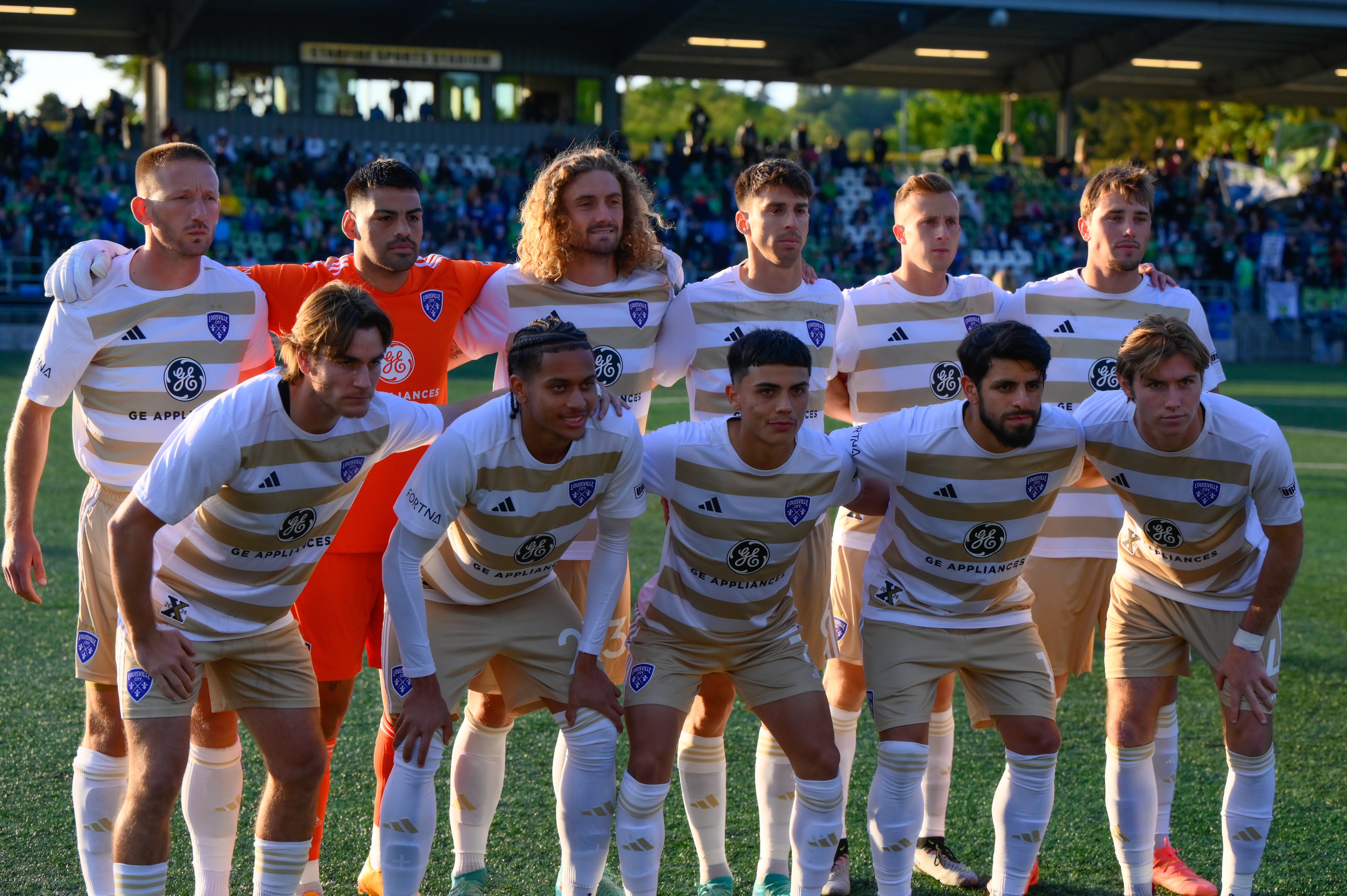
Days before Major League Soccer is set to kick off its 30th season as the lone Division 1 soccer league in the United States, the United Soccer League issued its biggest signal yet that it was looking to change the landscape of the sport: it announced on Thursday that’s set to launch a top-flight league in the 2027-28 season, right after the World Cup.
“It’s a key moment for soccer in this country, and as we see where this game is going, we want to be a part of it,” Paul McDonough, president and chief soccer officer of the USL, told The Athletic.
Clearly, McDonough — the former director and later VP of soccer operations at Atlanta United — and his colleagues at the USL feel there’s room enough for two Division 1 soccer leagues in the U.S. But are they right?
The last time a league attempted to mount a challenge against MLS came last decade, as the NASL in 2015 sought to move from D2 to D1 status but pushed back on U.S. Soccer’s proposed requirements: a stadium of at least 15,000, a minimum of 16 teams, and at least 75 percent of the teams being in metro areas of at least 2 million. (The NASL would fold a couple of years later and eventually filed an antitrust lawsuit against MLS and U.S. Soccer, which it lost.)
Now, the USL is looking to position itself as a league of choice in top-flight men’s soccer. They’re already working on that in women’s soccer: the USL Super League, launched as a competitor to the NWSL, was granted D1 status. (There’s nothing in the U.S. Soccer bylaws preventing multiple D1 men’s or women’s leagues. )
At the very least, USL D1 (which we’ll call it from here on out) will need to have a minimum of 12 clubs at launch and apply to get up to 14 by Year 3. The 15,000-seat stadium requirement will hold, but three-quarters of its teams will be required to be in locales of 1 million or more (versus the 2 million floated by U.S. Soccer previously). Teams will also need to be in the Eastern, Central, and Pacific time zones; that’s not to mention prospective owners will need to prove that they have funds to operate a club for at least 5 seasons.
The USL’s immediate focus, then, will likely be to identify the charter members of USL D1, a process that will likely see the more promising (read: richer) USL Championship clubs fill things in at the top level initially. Naturally, it’s not hard to see promotion/relegation play out between USL D1, the Championship, and USL Leagues 1 and 2 as it won’t be a single-entity league like MLS. There could be a world someday where a deep-pocketed owner infuses a Championship club with cash and sights set on competing in the first division.
But while pro/rel might be a few years off — which would be a move celebrated by soccer purists nationally — there’s one key differentiator that will play out immediately in USL D1: notice that it’s set for launch in the “2027-28 season”. It’s obvious that the USL is looking to debut USL D1 on the European calendar like it has with the USL Super League.
So will a second D1 league work?
MLS is the 10-ton gorilla, loaded with owners worth nine, and even 10, figures. It also helps that it has a 30-year head start on the proceedings. Turning briefly back to the USL Super League: it will be tough to shed the possible perception among fans (and, let’s face it, players) that it’s a second-tier league to the NWSL despite both being in the top flight. As it will with USL D1, getting rid of that reputation will come with time. How can USL D1 recruit players of repute? How can its academy structure measure up to that of the FC Dallases, the Philadelphia Unions, and New York Red Bulls of the world? How can it bring in fans already sold on the product MLS provides, and not only that, position itself globally? If pro/rel is adopted, how will U.S. Soccer’s bylaws change to account for the system, or how will the USL navigate the existing ones?
For MLS, how will it respond to this possible challenge? Will it look to relax its byzantine roster rules and allow wider spending? The cash-for-player trade model and its DP or U-22 focused structure are good first steps, but they’re just that: first steps. While MLS Season Pass seeks to further improve its product, how can the league harness audiences from the other side of the paywall?
As of this writing, there are many blanks to fill. A cynic will say it’s likely such a project won’t ever get off the ground. But if it does, professional soccer in the United States may not be the same — for better or worse.
Help support independent Atlanta soccer coverage
Every week, Scarves and Spikes brings you original interviews, on-site coverage, live shows/podcasts, and the analysis you won’t find at the bigger national outlets. With 2026 being a World Cup year, Atlanta United facing yet another important transfer window, the U.S. Soccer National Training Center setting up shop in the Atlanta area, and NWSL Atlanta kicking off in 2028, your support helps us do even more.
What you get on Patreon:
- Atlanta United training ground updates
- Exclusive interviews, like our recent sit-down with ATL UTD 2 head coach Jose Silva
- Discord access, talk Atlanta soccer with the SnS team and other supporters
- Patreon-only mailbags
- Grey Gowder’s analytical deep-dives on roster construction, the academy, ATL UTD 2, and more
Membership starts at $5/month. New subscribers get a 7-day free trial.
I’m more optimistic about USL and this new USL Premier League.
USL has spent the last decade building stability, depth, financial sustainability, and independence from MLS. Atlanta’s former salary cap mastermind Paul McDonough and his team are making this move to tap into the strong ambitions of some of his current and future highly motivated ownership groups, who are no longer content to remain in a lower division, and who have been spurned by the MLS Expansion process.
A little bit of background on USL and how it differs from MLS. Unlike MLS’s single-entity ownership model, each USL club is its own business. USL owns its competition pyramid from 4th division semi-pro up to 2nd division men’s professional and 1st division women’s professional.
USL has also greatly loosened up its roster construction rules from the time it used to host MLS reserve teams. It has rapidly increased its number of talented international players from the Caribbean, Central and South America, and Africa. The league has also heavily invested in developing local talent by creating new roster spots entirely for U-18 academy players who can make their debuts with the first team while still on contracts with their USL Academy League teams, eliminating “territories” for academy recruitment, and allowing teams like Orange County to become attractive destinations for disgruntled MLS Academy talents looking to start their professional careers earlier. Teams can spend and build their rosters based on their means with the financial boon of developing and selling young talents highlighted as a lucrative option (see Orange County, Louisville, and Charleston).
USL also has a far more visible media partnership than MLS. While MLS has locked itself behind the Apple+ bubble for a decade, USL has built streaming and national broadcast partnerships with CBS and ESPN that have helped their in-person and televised viewership more than triple in the last decade. There has been continued improvement in competition quality, and the increasingly community-focused nature of the teams (see Oakland Roots). New waves of investment groups building clubs for the USL’s men’s and women’s (that’s right, USL is already taking on NWSL) competitions continue to pour money and interest into the league as we rush toward the 2026 World Cup.
The timing of this is very important. USL is targeting 2027-2028 as the start date for the new league. This coincides with their planned schedule shift from the current March – November system to August to May. College soccer is looking to do the same thing and has coincidentally been in talks to move top men’s programs to the USL 3rd division. 2027 is also when USL’s current streaming/broadcast deal is up, so the enticing storylines of new markets, a new top league, and the path to pro/rel are all in play to make the next media deal more lucrative, visible, accessible, and profitable through revenue sharing. Meanwhile, MLS will be stuck with Apple for another 5 years.
“But what about Pro League Standards?” you may ask. US Soccer has granted waivers in the past to help USL Championship teams establish their stadiums, team numbers, and financial backers. This is also a very different US Soccer leadership group than the one that torpedoed NASL a decade ago in the last soccer wars. This one is not as beholden to MLS and could see the benefits of growing the game across our country rather than locking into an artificially small pay-to-play pool. This new USL pyramid of three functioning professional leagues and an amateur/semi-pro league all operating under the same league structure would create the best possible opportunity for promotion and relegation in the US. Couple that with US Soccer’s strong desire to modernize and professionalize Division-1 men’s college soccer, and we could see new tiers added to the US soccer pyramid and a rewriting of Pro League Standards for the US Soccer Pyramid. The goal of US Soccer and USL is to effectively identify and develop as many young players as possible as early as possible through increased coaching and officiating standards, strong community-focused clubs, strong regional competition, and more pathways to the professional game. USL is doing a much better job in pursuing those goals than MLS.
Rather than worrying about whether USL will fail, the real possibility we should be considering is how long it will take for MLS clubs to have enough of MLS’s nonsense and start making the business decision to switch to a league that gives them the freedom to spend, build rosters, and develop the identity that they want rather than get stifled by the single entity. That could be a very real story a decade from now.
It will be interesting to see how they fare playing August to May, viewership wise. Soccer fans will follow but they’ll compete for eyes with football and Euro football. There is some cross over of dates currently but for the entire season?
Not a huge NFL fan these days, but historically a lot of rule changes, play-style changes, etc. have come to the NFL from competing leagues. That’s what I am probably most excited about here. USL D1 may fail, but that could be ok in the long run if it changes the MLS for the better. For me, ideally, USL D1 turns in to the MLS Championship once the MLS gives in to pro/rel…as it should have from the beginning before MLS went all imperial. A boy can dream.
Competition is good.
More soccer is better than less.
Good on them for attempting to ride the World Cup wave of excitement that’s on it’s way! We wouldn’t have a successful MLS if we didn’t host the Cup in ’94.
Seems like a missed opportunity for them to launch after the world cup instead of during or right before. I’m sure they couldn’t do it in time for that financially and organizationally, but feels like they missed a window that would have made it easier.
It is perfect timing for them. They are coming off of the high of the World Cup and won’t be competing for air time. They will also be starting a new TV/streaming deal then and will be switching to an August-May (or June) schedule. Also, most of their committed expansion teams will be in place by 2027.
And then there’s the strong potential of the top men’s college soccer teams professionalizing, including a brand new SEC men’s college soccer conference.
USL? More like USFL, amirite?
Exactly. Trying to set up teams in major metro areas that already have MLS teams will be challenging (to say the least). Imagine a USL team playing at Bobby Dodd or at GA State’s stadium trying to compete with AtlUtd at MBS (not going to work). The same will be true in most other major metro areas – and with most of the MLS owners being capable of easily outspending any USL owners, that also presents a challenge for USL.
USL is trying to bring a woman’s & men’s team to Roswell, GA. And build a 10,000 to 15,000 seat stadium as well.
The article in The Athletic about this didn’t say anything about the USL trying to compete in MLS cities, but instead called out Louisville, Sacramento, Indianapolis, Phoenix and Las Vegas (all current USL cities that would probably move up into USL 1) and said there are “more markets” outside the top 30 – 32 (where MLS is/will be soon.) Other potential cities with over 1M people include but are not limited to Detroit, Pittsburgh, Cleveland, Tampa, Baltimore, San Antonio, Jacksonville, Providence, Raleigh, Oklahoma City, Memphis, Richmond, and several more.
They are also looking at metro area trends for places like Charleston which will pass 1 million by the end of the decade, Birmingham is over 1 million, several California locations, Brooklyn, and direct challenges to MLS teams that are underperforming in their metro areas like Dallas.
MLS will likely respond initially by pretty much pretending USLD1 doesn’t exist, at least in terms of letting MLS squads play against USLD1 squads to the degree they can prevent it or talking about the “other league” much at all publicly.
They would do this until they are forced to acknowledge them, and that happens only if a lot of money comes in to the league in the form of a TV contract and deep pocket owners that start poaching the best MLS players and/or outbidding MLS teams for transfers. They will also need to build and fill bigger stadiums. The average MLS stadium capacity is around 30k, twice the requirement for USL. It’s hard to be seen as on par with MLS when your stadiums are maybe half the size – sorta like how UGA fans like to make fun of Tech’s high school stadium.
That said, this is probably a decent time for USL to try it. MLS is the main league but they are not really NFL-level entrenched in the sports landscape and their games are streamed through a service rather than broadcast on a TV network available on all cable/satellite systems. If USL can get a TV contract that everyone can get without having to pay extra, that will go a long way towards raising their profile to a level where they truly can compete with MLS.
The TV contract is the rub. Probably not Apples to Apples comparison but LIV golf can only get on TV through the CW Network. And they basically pay to do so. If you look at their viewership, it is lower than bottom of the league ACC college football. Good luck to them, I guess.
USL currently has a more accessible TV/streaming deal with CBS and ESPN than MLS does. This announcement was the beginning of negotiations for the next media package deal that is set to start in 2027.